Known as the “powerhouses of the cell,” mitochondria produce the energy necessary for the cell’s survival and functioning.
A key driver of mitochondrial function is Coenzyme Q10 (CoQ10), also known as ubiquinone, which is a vitamin-like fat-soluble substance found in the inner mitochondrial membrane of cells. CoQ10 is one of the key molecules involved in the electron transport system, which helps generate energy through the formation of adenosine triphosphate (ATP), which drives cellular function and life.
BPGbio has developed a therapy that increases the levels of CoQ10. In many mitochondrial diseases, restoring or increasing CoQ10 levels can overcome the effect of mutations in genes that lead to mitochondrial dysfunction. This restoration of energy generation can minimize tissue damage from toxic metabolites and preserve function in organs like the brain, heart, and kidney.
What is Primary CoQ10 Deficiency (PCQD)?
Primary CoQ10 Deficiency (PCQD) is a rare but often severe multisystem disease caused by mutations in one of at least ten genes required for CoQ10 biosynthesis, leading to significantly reduced CoQ10 levels.
This deficiency impairs mitochondrial energy production and can result in dysfunction across multiple organ systems, including the central nervous system, heart, skeletal muscle, kidneys, and liver. Clinical manifestations may appear from infancy through adulthood, depending on the severity of the genetic defect.
It is estimated that less than one in 100,000 people are affected with PCQD in the United States. These are likely underestimates due in part to its rarity resulting from misdiagnosis or lack of adequate genetic testing. One study estimated ~200 people affected in the United States; however, it noted the number could be higher if we expand to “predicted” generic variation (the study can be found here).
Historically, PQCD has been treated with oral supplementation of CoQ10. However, oral supplementation has not shown consistent efficacy due to varying formulations and low bioavailability (see below).
BPM31510 has high potential for
Primary CoQ10 Deficiency
BPGbio’s BPM31510(IV) has high therapeutic potential for Primary CoQ10 Deficiency
Derived from our NAi Interrogative Biology® Platform using Bayesian methodologies, BPM31510(IV) is a novel, highly bioavailable, CoQ10-based therapy that uses a proprietary nanoparticle formulation to overcome the bioavailability limitations of traditional oral CoQ10 supplementation.
Administered via IV, BPM31510 is:
a stable proprietary formulation
contains oxidized CoQ10
a bio-membrane like capsule
offers high bioavailability
achieves high levels in mitochondria
BPM31510 is formulated to optimize tissue uptake and impact mitochondrial function. Critically, BPM31510 achieves high circulating levels after infusion and is known to be delivered to the brain and other organs.
In vivo CoQ10 levels in blood plasma and muscle tissue show tremendous differences when given in equal doses via oral OTC versus BPM31510-IV in experimental models.
BPM31510-IV increased CoQ10 levels >500x in plasma, and >50X in muscle tissue versus oral OTC CoQ10 which showed a negligible effect in both in experimental models.
BPM31510 addresses CoQ10 issues in a highly underserved population
Rare diseases often have many hurdles in therapeutic development. Thanks to our NAi Interrogative Biology® Platform we can overcome many of them and offer new novel therapeutics, such as BPM31510, to these underserved populations.
BPM31510’s mechanism of action is promising as a treatment for PCQD:
It addresses lackluster success rates of oral CoQ10 replacement due to poor blood and tissue penetration
It is a highly bioavailable form of CoQ10 administered parenterally
CoQ10 therapy has shown limited benefit in treating PCQD, as it has historically achieved only 2–4× higher CoQ10 levels in plasma above baseline, while BPM31510 has demonstrated levels more than 900-fold above baseline with a favorable safety profile.
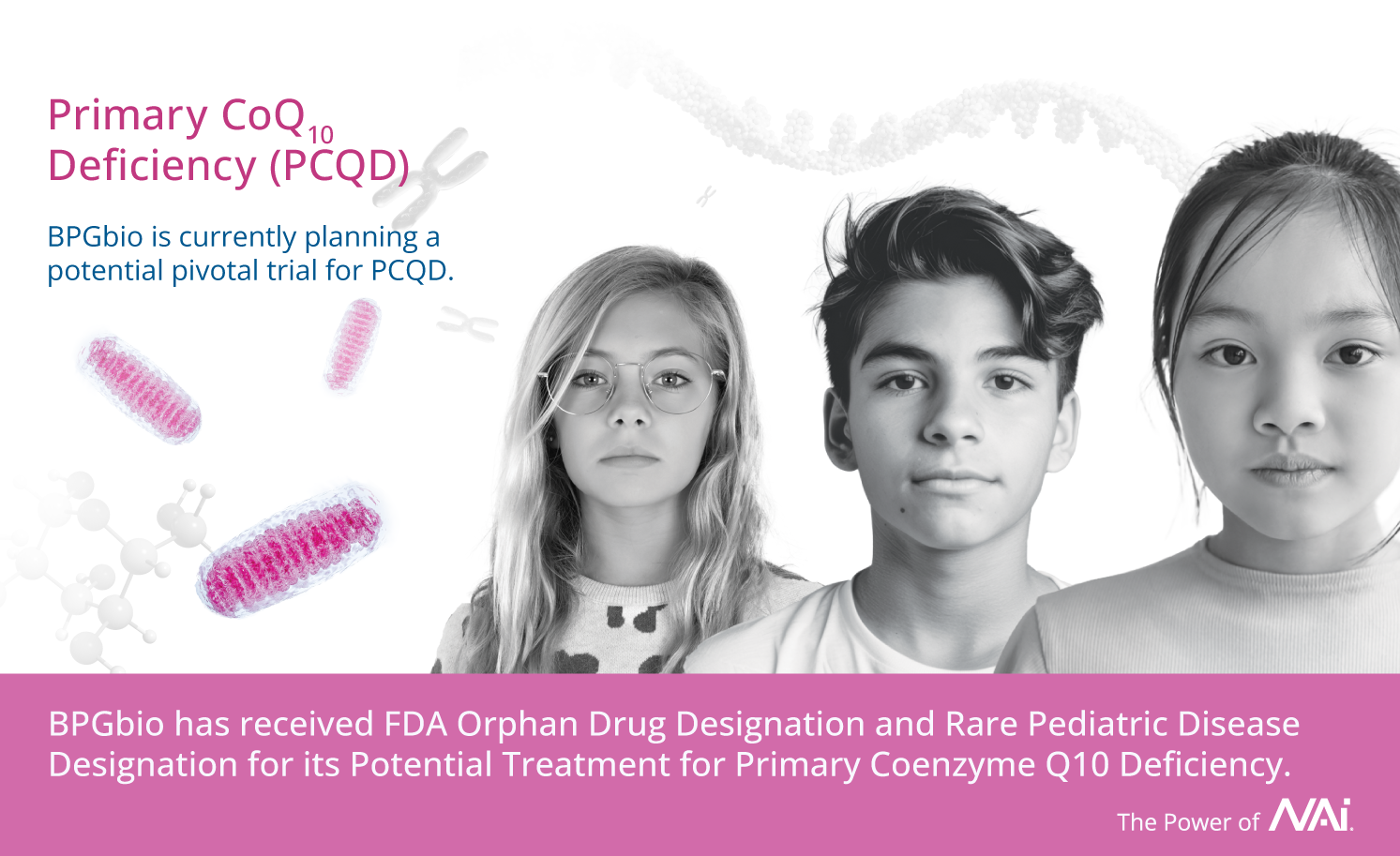
We are currently planning a potential pivotal trial for PCQD.
BPGbio has received FDA Orphan and Rare Pediatric Disease Designation for its Potential Treatment for Primary Coenzyme Q10 Deficiency.
Additionally, BPM31510 demonstrated a tolerable safety profile in clinical trials and is currently being studied as an oncology drug candidate for two disease indications:
1DiMauro S, Schon EA, Carelli V, Hirano M. The clinical maze of mitochondrial neurology. Nat Rev Neurol. 2013;9:429-44. [PMC free article] [PubMed] [Reference list]
BPGbio GBM Ph2 Trial-In-Progress Update at SNO 2023 Poster
If you would like a PDF of the BPGbio GBM Ph2 SNO 2023 Poster presentation, please fill out the form below and you will receive a link to download it at the email you provide.
GMB Ph2 SNO 2023 Poster
Sign up to receive the BPGbio GBM PH2 SNO 2023 Poster here. Upon submission the PDF will be emailed to the address you provide.
Cookie Consent
We use cookies to improve your experience on our site. By using our site, you consent to cookies.
This website uses cookies
Websites store cookies to enhance functionality and personalise your experience. You can manage your preferences, but blocking some cookies may impact site performance and services.
Essential cookies enable basic functions and are necessary for the proper function of the website.
Name
Description
Duration
Cookie Preferences
This cookie is used to store the user's cookie consent preferences.
30 days
Statistics cookies collect information anonymously. This information helps us understand how visitors use our website.
Google Analytics is a powerful tool that tracks and analyzes website traffic for informed marketing decisions.
Contains information related to marketing campaigns of the user. These are shared with Google AdWords / Google Ads when the Google Ads and Google Analytics accounts are linked together.
90 days
__utma
ID used to identify users and sessions
2 years after last activity
__utmt
Used to monitor number of Google Analytics server requests
10 minutes
__utmb
Used to distinguish new sessions and visits. This cookie is set when the GA.js javascript library is loaded and there is no existing __utmb cookie. The cookie is updated every time data is sent to the Google Analytics server.
30 minutes after last activity
__utmc
Used only with old Urchin versions of Google Analytics and not with GA.js. Was used to distinguish between new sessions and visits at the end of a session.
End of session (browser)
__utmz
Contains information about the traffic source or campaign that directed user to the website. The cookie is set when the GA.js javascript is loaded and updated when data is sent to the Google Anaytics server
6 months after last activity
__utmv
Contains custom information set by the web developer via the _setCustomVar method in Google Analytics. This cookie is updated every time new data is sent to the Google Analytics server.
2 years after last activity
__utmx
Used to determine whether a user is included in an A / B or Multivariate test.
18 months
_ga
ID used to identify users
2 years
_gali
Used by Google Analytics to determine which links on a page are being clicked
30 seconds
_ga_
ID used to identify users
2 years
_gid
ID used to identify users for 24 hours after last activity
24 hours
_gat
Used to monitor number of Google Analytics server requests when using Google Tag Manager