
The Importance of CoQ10 and Mitochondria
A key driver of mitochondrial function is Coenzyme Q10 (CoQ10), also known as ubiquinone, a vitamin-like fat-soluble molecule located within the inner mitochondrial membrane. CoQ10 plays a central role in the electron transport chain, the process responsible for generating adenosine triphosphate (ATP) — the primary energy currency that powers cellular function and sustains life.
In many mitochondrial diseases, restoring or increasing CoQ10 levels can overcome the effect of mutations in genes that lead to mitochondrial dysfunction. This restoration of energy generation can minimize tissue damage from toxic metabolites and preserve function in organs like the brain, heart, and kidney.

What is Primary CoQ10 Deficiency (PCQD)?
Primary CoQ10 Deficiency (PCQD) is a rare but often severe multisystem disease caused by mutations in one of at least ten genes required for CoQ10 biosynthesis, leading to significantly reduced CoQ10 levels.
This deficiency impairs mitochondrial energy production and can result in dysfunction across multiple organ systems, including the central nervous system, heart, skeletal muscle, kidneys, and liver. Clinical manifestations may appear from infancy through adulthood, depending on the severity of the genetic defect.

It is estimated that less than one in 100,000 people are affected with PCQD in the United States. These are likely underestimates due in part to its rarity resulting from misdiagnosis or lack of adequate genetic testing. One study estimated ~200 people affected in the United States; however, it noted the number could be higher if we expand to “predicted” generic variation (the study can be found here).
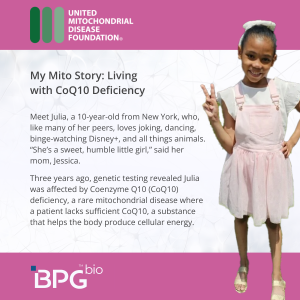
Read Julia’s full My Mito Story: Living with CoQ10 Deficiency.
PCQD Needs Pharmaceutical Grade Therapies
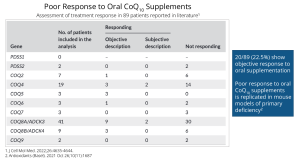
Historically, PCQD has been treated with oral OTC Oral CoQ10 supplement. However, oral supplementation has not shown consistent efficacy due to varying formulations and low bioavailability (see below).

BPGbio’s BPM31510 is engineered using lipid nano technology to be an NCE (novel chemical entity) delivery platform containing oxidized CoQ10.
BPGbio’s BPM31510-IV for PCQD
BPM31510-IV is designed to address CoQ10 issues in a highly underserved population.
BPM31510-IV is a novel delivery platform that uses a proprietary nanoparticle formulation to overcome the bioavailability limitations of traditional oral CoQ10 supplementation.
Administered via IV, BPM31510:
- is a stable proprietary formulation
- is a bio-membrane like capsule
- contains oxidized CoQ10
- offers high bioavailability
- achieves high levels of CoQ10 in mitochondria
BPM31510 is not yet approved by the FDA.
BPM31510 PCQD Clinical Trial Status
We are currently planning a pivotal phase 3 trial for PCQD.
BPGbio has received FDA Orphan and Rare Pediatric Disease Designation for its Potential Treatment for Primary Coenzyme Q10 Deficiency.
Additionally, BPM31510 demonstrated a tolerable safety profile in clinical trials and is currently being studied as an oncology drug candidate for two disease indications:
Ongoing phase 2 trial for GBM here.
Phase 2 trial for Pancreatic Cancer here.
PCQD Clinical & Scientific Posters
UMDF 2026 – Quinomics Assessment Reveals That BPM31510 Increases The Q Pool in Preclinical Mouse Models of Primary CoQ Deficiency That Present With Encephalopathy or NephropathyUMDF 2026 – Intravenous BPM31510 for treatment of pediatric patients with primary CoQ10 deficiencyEuroMIT 2026 – Intravenous BPM31510 for treatment of pediatric patients with primary CoQ10 deficiencyMitoCon 2026 – BPM31510 Increases The CoQ Pool In Cerebellum As Assessed By Spatial Quinomics And Restores Kidney Function In Preclinical Models Of CoQ DeficiencyMitoCon 2026 – Initial experience using intravenous BPM31510 for treatment of pediatric patients with CoQ10 deficiency
For more posters head to our poster archive here.
